|
crwdns2933307:0crwdne2933307:0 crwdns2934263:00crwdne2934263:0 |
Detecting wrong mmHg, that is not working after Fall from my hand |
Background and Identification
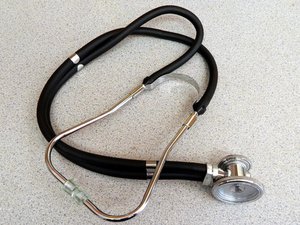
Perhaps one of the most iconic of medical devices, the stethoscope is a diagnostic tool used to listen to sounds inside the human body.
A modern stethoscope usually consists of flexible tubing connecting eartips (which are inserted into the practitioner’s ears) to a chest piece or “head” that is placed against the patient’s body. The head of a stethoscope can take numerous forms, but it commonly contains a flat, circular diaphragm that helps amplify sound. Dual-head stethoscopes have a larger enclosed drum-like diaphragm on one side and a smaller hollow cup-like bell on the other. The diaphragm is optimized for listening to higher-frequency sounds, while the bell is optimized for listening to lower-frequency sounds.
There are numerous types of stethoscopes, including:
- Acoustic stethoscopes: These operate by conducting sound waves directly from the head to the eartips through air-filled tubes. Sound volume is generally quite low.
- Electronic stethoscopes: These operate by converting acoustic sound waves to electrical signals, which can then be electronically processed, amplified, digitized, and recorded. The chest piece often contains a microphone or piezoelectric crystal and earpieces may be wireless.
Additional Information
- Wikipedia: Stethoscope
- Telegraph article: A History of the Stethoscope
- Best Stethoscope Guide: 10 Types of Stethoscopes: What’s the difference?
- Top Nurse Info: How to Use a Stethoscope